


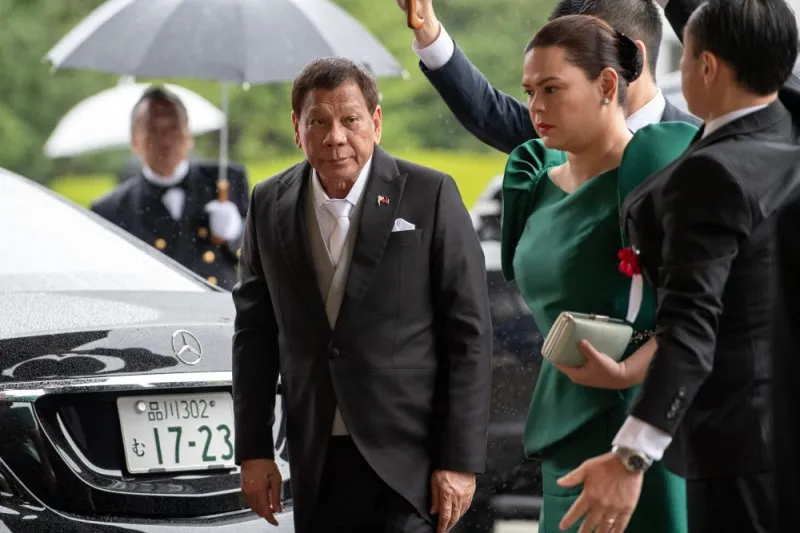
Rodrigo Duterte faces three counts of crimes against humanity for indirectly co-conspiring to murder or attempt to murder alleged drug users or pushers during his so-called ‘war on drugs’ in the Philippines. — AFP file pic
Stay updated on the latest news and insights. Subscribe to our newsletter here
 Make Malay Mail your preferred source on Google Giving you news that matter to Malaysians. Make Malay Mail your preferred source when you search for news on Google.
 Giving you news that matter to Malaysians. Make Malay Mail your preferred source when you search for news on Google.

THE HAGUE, Nov 26 — Former Philippine president Rodrigo Duterte stands trial from Monday at the International Criminal Court in arguably the highest-profile case in the institution’s 24-year history.
Duterte is the first Asian former head of state to appear at the ICC and his trial comes as the court faces unprecedented global pressure, including sweeping sanctions from the United States.
Here are five key things to know about the blockbuster trial:
What are the charges?
Duterte faces three counts of crimes against humanity for indirectly co-conspiring to murder or attempt to murder alleged drug users or pushers during his so-called “war on drugs.”
He is charged with what ICC pre-trial judges called a “widespread and systematic attack against a civilian population” while he was mayor of Davao City and then president of the country.
The court will examine 49 incidents that resulted in the deaths of 76 people, with two attempted murders.
However, these incidents are “mere examples of the extent of the victimisation”, according to prosecutors.
The ICC said hundreds were killed during the time Duterte was mayor, with thousands then murdered when he became president.
Count one relates to 19 alleged murders carried out between 2013 and June 2016, when Duterte was Davao mayor.
The court will examine nine incidents.
Count two relates to the alleged murder of “High Value Targets” between July 2016 and July 2017 during Duterte’s presidency.
Five incidents will be considered, with 14 deaths.
Count three concerns 35 incidents during so-called “barangay (village) clearing operations”.
A total of 43 murders and two attempted murders is alleged.
How does the trial work?
The first day will be action-packed with spectators cramming into the public gallery and hundreds of Duterte supporters and victims expected to demonstrate outside the court.
Judge Joanna Korner will read out the charges to the 81-year-old, ask if he understands them and if he pleads guilty or not guilty.
The prosecution will make its opening statement (expected to last around three hours), followed by victims’ representatives (less than three hours).
Defence lawyer Peter Haynes has said he is “inclined” to respond after the prosecution and victims make their opening statements.
After opening statements, the prosecution sets out its case.
Around 100 witnesses are expected.
Victims’ representatives will then present their observations, followed by the case for the defence.
Duterte is innocent until proven guilty “beyond reasonable doubt.”
He can appeal any verdict.
How long will this last?
Probably several years.
The prosecution alone has been given 150 hours to present its case.
This does not include cross-examination by the defence.
Judge Korner has set a maximum of four hours sitting per day given Duterte’s age and fragile health.
There will also be regular breaks in proceedings.
After the trial has finished, the panel of three judges will issue their verdict “within a reasonable period of time.”
In the past, the ICC has taken more than a year to issue a verdict and the Duterte case is expected to take a long time given the complexity and stature of proceedings.
Is he fit to stand trial?
Duterte’s health has been a major topic in the run-up to the trial but judges have ruled him fit to take the stand, based on findings from an independent panel of doctors.
During his initial appearance, via videolink in March 2025, the former leader appeared dazed and disorientated, his speech barely audible.
His defence team has said he is suffering from “significant memory impairment” that means he often fails to remember his lawyer’s name.
He has been excused many times from appearing in person during pre-trial hearings, but Korner has said she expects him in court every day for the trial.
He appeared in court in person for the first time in September, seeming to follow proceedings and waving at the public gallery when the hearing ended.
What sentence does he risk?
At the ICC, sentencing is a separate procedure entirely.
Life imprisonment is extremely rare and time already detained is subtracted from the prison time.
The court could also order reparations for victims if Duterte is convicted.
This too is a separate procedure. — AFP